Friday, September 7, 2012
Day Five: Arrival Of The Soldiers
August 19, 2012
Program began again at 8 with the introduction of the eight Israeli soldiers who would be joining us for the remainder of the trip. They've been granted a privilege that few soldiers get to experience, taking a vacation of sorts from their military responsibilities usually a few months before completing their service. There are four women and four men all coming from different parts of the military doing jobs ranging from social work to base security. Depending on the activity, they alternate between civilian clothes and military uniforms.
After we got acquainted a bit, we all headed off to the modern wall at the eastern edge of the city where there is a checkpoint to the West Bank (above). Speaking to some of the soldiers, they seemed a little nervous to be so close to the area that has been a source for many suicide bombers. At the moment, the wall seems like a necessary evil to deter such attacks, and safety has become much less of a concern in Jerusalem since its construction. Unfortunately, it has many detractors, such as: it's demeaning to the Palestinians, it slows and/or blocks passage of all people including Jews who travel between sides for home and work, it strips the olive orchard land at the border from the Palestinians' whose property it was, it puts great matters of security in the hands of teenage soldiers at the checkpoint often dealing with tough judgement calls, it looks hideous, and it's ecologically questionable. However, for security's sake, it seems like the best solution for the problem at the moment. Our guide told us that walking Ben Yehuda street, as we had the night before, was a dangerous proposition ten years earlier that is no longer an issue in large part thanks to the wall.
Next we returned to the market on the edge of the neighborhood we'd walked the day before, this time in groups of eight with one soldier per group. We were assigned the task of finding out about different ethnic Jews who are represented in the market through a series of six questions that were different for each group. My group looked into Yemeni Jews, who immigrated en masse from the southern end of the Arabian Peninsula to Israel after the inception of the state. We were fortunate to be accompanied by our soldier, Nadav, who spoke fluent English as well as Hebrew and knew the answer to a few of the questions before we started in addition to knowing how to figure out the rest.
The market itself was not nearly as appealing as some of the others I've seen in Europe, although Nadav said it didn't compare well to the one he attends in Tel Aviv either. I heard another soldier describe it later as a peasant's market compared to Tel Aviv's. We did however get terrific sandwiches from one shop. Mine consisted of roasted eggplant, hard-boiled egg, hummus, and parsley on a really good baguette. Then, in the final ten minutes, we went about completing the six tasks of the scavenger hunt related to Yemeni Jews. We got a joke: "How do you get 100 Yemenites into a truck? Throw a shekel inside." We got a picture with two Yemeni people, and we bought some juice with the traditional Yemeni herb "khat." Apparently it is chewed by many like tobacco, and it is said to give you a slight high, greater wisdom, and help with erectile dysfunction. (Note: Khat is illegal in the United States and Israel began cracking down on the sale of highly concentrated khat juice during the time we were in Israel.)
Each group presented their findings, particularly highlighting the food, at a park not too far away from the market. The other groups included Ashkenazi, Georgian, Indian, Turkish, and Sephardic. While the competition was supposed to be judged, it seemed like everybody had thrown together their presentation rather last minute, and no results or prizes were eventually given out by the chaperones and tour guide.
I don't know how to describe the above except as a sort-of nut-based cake, from "The Shuk."
We were then supposed to have a speaker on another subject, but she had to cancel last minute for personal reasons, and our trip organizer found us an alternate activity to fill the next hour: attending a historical movie on the history of Jerusalem. This was no ordinary movie though. It was not in 3D—although there are showings in 3D at this historical museum-theater. We were arranged into several little sections of roughly ten people, each sitting on its own separate moving platform. As we progressed through "The Time Elevator," narrated on camera by Chaim Topol, we were shaken up and down and occasionally sprayed with water because "the machine still had some malfunctions." Despite the fact that the theater looked like it was opened in the early 90's, Nadav told me it was only about ten years old, and he remembered riding it when it opened thinking it was a bit dopey back then too. I think the biggest problem for most of us was we were just exhausted, and sitting in a dark movie theater, despite the fact that it was rocking us back and forth, just induced more sleepiness and a lack of concentration.
Fortunately, we were given a break right after the movie, and people divided their time between napping and swimming. I was hanging out in the hall during some of the time, writing on my computer, when a few of my friends came up and started chatting. They had asked to hear my music before, so I took the opportunity to play a tune or two. As I played, more of our peers came walking by and stopped to listen. Everybody seemed to really like it, so I kept playing, and word started getting around, so as some left, others arrived asking to hear more. It was a real pleasure for me to share some of my music to such an appreciative audience that assured me they enjoyed it firstly as music and secondly because it was mine.
After dinner at the hotel, we got to screen two short films with an Israeli filmmaker, both made by people near us in age so we could see what our Israeli peers were interested in portraying on camera. The first, made by our host, Yishai Goldflam, when he was in school, followed a group of orthodox Jews on a Shabbat camping trip. The leading male of the group had become involved in a serious relationship with a secular Jewish Israeli who was not at all interested in following the traditions. While the orthodox Jews look down upon the secular woman, the relationship reaches a point where both characters realize something has to change, and compromise is necessary. The particular issue comes to a head when the male protagonist cannot cross the string eruv set up around the campsite as a boundary within which they can hold objects without it being considered work in Jewish tradition. At this point she leaves, and he finally takes one step outside the eruv, but she decides to take off anyway. This led to a great discussion where different members of our group supported both characters' beliefs and were infuriated that the other was too self-centered to compromise. I think the fact that we were able to get such a split discussion is a tribute to the filmmaker taking his personal beliefs out of the narrative and allowing the audience to form their own opinions of the situation when given the same facts.
The second film included lighting design by our host and followed an Israeli soldier as he becomes distracted by a pretty Palestinian woman in the scope of his weapon on patrol, losing focus of the intended terrorist target. As he receives the call from a senior officer to shoot the terrorist, the woman with whom he has become infatuated is being beat by a Palestinian man, a short distance away, and he decides to shoot the civilian instead of his terrorist target. This too brought out a very split debate about what was the moral thing to do: shoot the commanded target that may lead to greater death later or take out the man who is visibly doing harm to a woman at the moment. While the Israeli soldiers were adamant about taking out the target, and most agreed that was the more procedurally right thing to do, there was certainly a sentiment in the room that it made sense to take care of the woman more visibly in harm.
Both were fascinating films, and got us thinking and talking about some more modern Israeli conflict that was not specifically about the safety of a Jewish state in the Middle East. Both the films and the filmmaker were engaging and made current Israeli life more relatable. We were then dismissed for the evening, with the advisement that we should get to bed early before a particularly long and difficult day to follow.
Promotional photo for "The Time Elevator." [www.allaboutjerusalem.com]
Wednesday, September 5, 2012
Day Four: Shabbat
August 18, 2012
Although I was up later than usual the previous night, breakfast closed by 10, so I made sure to get up by 9 and grab a bite before our program began at 10:45. We headed off again on foot to a nearby market and neighborhood, which showed an interesting collection of houses on narrow pedestrian streets. I found it most fascinating that the streets were worn and often littered, but many houses were adorned with pots overflowing with flowers, and there were several places of worship in particular marked with ornate art. There was a dichotomy between the ware of the neighborhood and the great care for it as well.
Team Shlomo stays out of the sun at the Machane Yehuda Market, otherwise known as "The Shuk." [taken by Samantha Gellman]
Jerusalem's Nachlaot neighberhood. [taken by Samantha Gellman]
We came back to the hotel for lunch and were given the rest of the afternoon off to relax during our day of rest. I ate quickly because I was not particularly hungry and realized I could get to the pool before it filled up, which was co-ed on Shabbat. I got about twenty minutes with just a few other patrons playing along the edges of the pool, doing some laps before the rest of the birthright crowd showed up from both my group and others staying at the hotel. It was wonderful workout I got before hanging around the pool with the rest of the group.
We next met with a lecturer from an Israeli news service who talked to us for roughly ninety minutes about the current political situation in Israel on both domestic and foreign policy. I can't say there was very much new I learned from the meeting, but the speaker was succinct and eloquent in presenting the issues. He held the attention of the whole group and even ran overtime for us because we continued to ask questions and wanted to further the conversation. My roommates and I concurred that it was a refreshing update on the current status quo of Israeli news.
As Shabbat came to a close, we held a small service in the hotel lobby, smelling a leaf of mint, lighting a double-wicked candle, extinguishing it in the kiddush wine, and then saying a few prayers which again led to a bit of dancing and lots of hugging throughout the group to ring in the new week.
After the service we were driven to Ben Yehuda street for food, shopping, and drinking. I split off with a group of nine to a lovely little restaurant on a back alley that Einat showed us, saying it was one of her favorites. Our waiter happened to be American, from New York and only a few years beyond her own birthright experience, now living in Israel. The decor was quaint, with candles for lighting and used books on all different subjects for sale covering the walls, but the food was the real star. We ordered two bottles of wine for the table: one white and one red from the Golan Winery. I believe we'd tried both the other day, but Golan's various labels had a monopoly on the wine at the restaurant. I ordered a pear roquefort ravioli which came in a sauce with a slight cinnamon oil glaze. It was really top notch food worthy of Italy or France, which I'd yet to have in Israel. Besides the meal itself, the company was great, as everyone was bubbling over with enthusiasm to be out on our own in Jerusalem.
After dinner I went with one of the other guys from my group of nine to look for a yarmulke while he searched for Shabbat candle holders. I lost my yarmulke about three years ago and hadn't found one I liked since then, so I planned to get one during the trip, which I knew would have the added significance of coming from Israel every time I wore it. My buddy didn't find candle holders he liked for the price he was willing to spend, so we headed over to the dance bar where most of the group planned to meet at the beginning of the night. I got a free drink and forty minutes of dancing with my new friends before having to head back to the bus with a quite merry group of peers. Getting back to the hotel around 12:30 after our big night in the city, everybody fell asleep pretty quickly, heading back into our 8:00 start schedule Monday morning.
Out on Ben Yehuda Street. [taken by Samantha Gellman]
Editor's Note: I didn't take any pictures myself on Shabbat. After all, it was the day of rest. Thanks to Samantha Gellman, one of my fellow Shlomos who did, and was able to add some visual cues to my narrative.
Although I was up later than usual the previous night, breakfast closed by 10, so I made sure to get up by 9 and grab a bite before our program began at 10:45. We headed off again on foot to a nearby market and neighborhood, which showed an interesting collection of houses on narrow pedestrian streets. I found it most fascinating that the streets were worn and often littered, but many houses were adorned with pots overflowing with flowers, and there were several places of worship in particular marked with ornate art. There was a dichotomy between the ware of the neighborhood and the great care for it as well.
Team Shlomo stays out of the sun at the Machane Yehuda Market, otherwise known as "The Shuk." [taken by Samantha Gellman]
Jerusalem's Nachlaot neighberhood. [taken by Samantha Gellman]
We came back to the hotel for lunch and were given the rest of the afternoon off to relax during our day of rest. I ate quickly because I was not particularly hungry and realized I could get to the pool before it filled up, which was co-ed on Shabbat. I got about twenty minutes with just a few other patrons playing along the edges of the pool, doing some laps before the rest of the birthright crowd showed up from both my group and others staying at the hotel. It was wonderful workout I got before hanging around the pool with the rest of the group.
We next met with a lecturer from an Israeli news service who talked to us for roughly ninety minutes about the current political situation in Israel on both domestic and foreign policy. I can't say there was very much new I learned from the meeting, but the speaker was succinct and eloquent in presenting the issues. He held the attention of the whole group and even ran overtime for us because we continued to ask questions and wanted to further the conversation. My roommates and I concurred that it was a refreshing update on the current status quo of Israeli news.
As Shabbat came to a close, we held a small service in the hotel lobby, smelling a leaf of mint, lighting a double-wicked candle, extinguishing it in the kiddush wine, and then saying a few prayers which again led to a bit of dancing and lots of hugging throughout the group to ring in the new week.
After the service we were driven to Ben Yehuda street for food, shopping, and drinking. I split off with a group of nine to a lovely little restaurant on a back alley that Einat showed us, saying it was one of her favorites. Our waiter happened to be American, from New York and only a few years beyond her own birthright experience, now living in Israel. The decor was quaint, with candles for lighting and used books on all different subjects for sale covering the walls, but the food was the real star. We ordered two bottles of wine for the table: one white and one red from the Golan Winery. I believe we'd tried both the other day, but Golan's various labels had a monopoly on the wine at the restaurant. I ordered a pear roquefort ravioli which came in a sauce with a slight cinnamon oil glaze. It was really top notch food worthy of Italy or France, which I'd yet to have in Israel. Besides the meal itself, the company was great, as everyone was bubbling over with enthusiasm to be out on our own in Jerusalem.
After dinner I went with one of the other guys from my group of nine to look for a yarmulke while he searched for Shabbat candle holders. I lost my yarmulke about three years ago and hadn't found one I liked since then, so I planned to get one during the trip, which I knew would have the added significance of coming from Israel every time I wore it. My buddy didn't find candle holders he liked for the price he was willing to spend, so we headed over to the dance bar where most of the group planned to meet at the beginning of the night. I got a free drink and forty minutes of dancing with my new friends before having to head back to the bus with a quite merry group of peers. Getting back to the hotel around 12:30 after our big night in the city, everybody fell asleep pretty quickly, heading back into our 8:00 start schedule Monday morning.
Out on Ben Yehuda Street. [taken by Samantha Gellman]
Editor's Note: I didn't take any pictures myself on Shabbat. After all, it was the day of rest. Thanks to Samantha Gellman, one of my fellow Shlomos who did, and was able to add some visual cues to my narrative.
Sunday, September 2, 2012
Day Three: Jerusalem
August 17, 2012
Our first activity for the day again began at 8:00 as we headed off to Mount Scopus overlooking the old city of Jerusalem (above). Our guide, Einat, pointed out several destinations within the old city, laying out the general geography for us along with some of the historical context for the city and its passage through the hands of many rulers through the past several thousand years.
Einat asked for volunteers to pour kiddush wine at the top of the mount, at which point I was nominated by a chorus of my peers, who at this point well knew my experience with wine. I impressed myself as well as some of my peers when I was able to pour 45 nearly even cups of wine from a single bottle, leaving only two servings to spare. At this point, I've become the "wine guy" in the group, with my peers every so often asking me about certain wine-drinking norms both during the day and after hours at the hotel bar.
We next headed into the old city, marked by the Ottoman-built wall during their time as rulers of the city. We walked along the southern perimeter from the Zion gate to the south end of the Temple Mount, which used to include several entrances to the top of the mount, which are now blocked with stone. Along the way we saw remnants of each of the former ruling groups, as vestiges of Ancient Israelite, Byzantine, Umayyad, Ottoman, and British civilizations sat alongside accommodations by the modern Israeli state.
Mishkenot Sha’ananim, the first Jewish neighborhood built outside the Old City, including the Montefiore Windmill.
The Ottoman wall around the old city.
The Dome Of The Rock, seen from the south end of the Jewish Quarter.
The southwest corner of the Temple Mount.
Einat, alone at stairs leading up to the south end of the Temple Mount (outside the Ottoman wall), where the former entrances are now blocked.
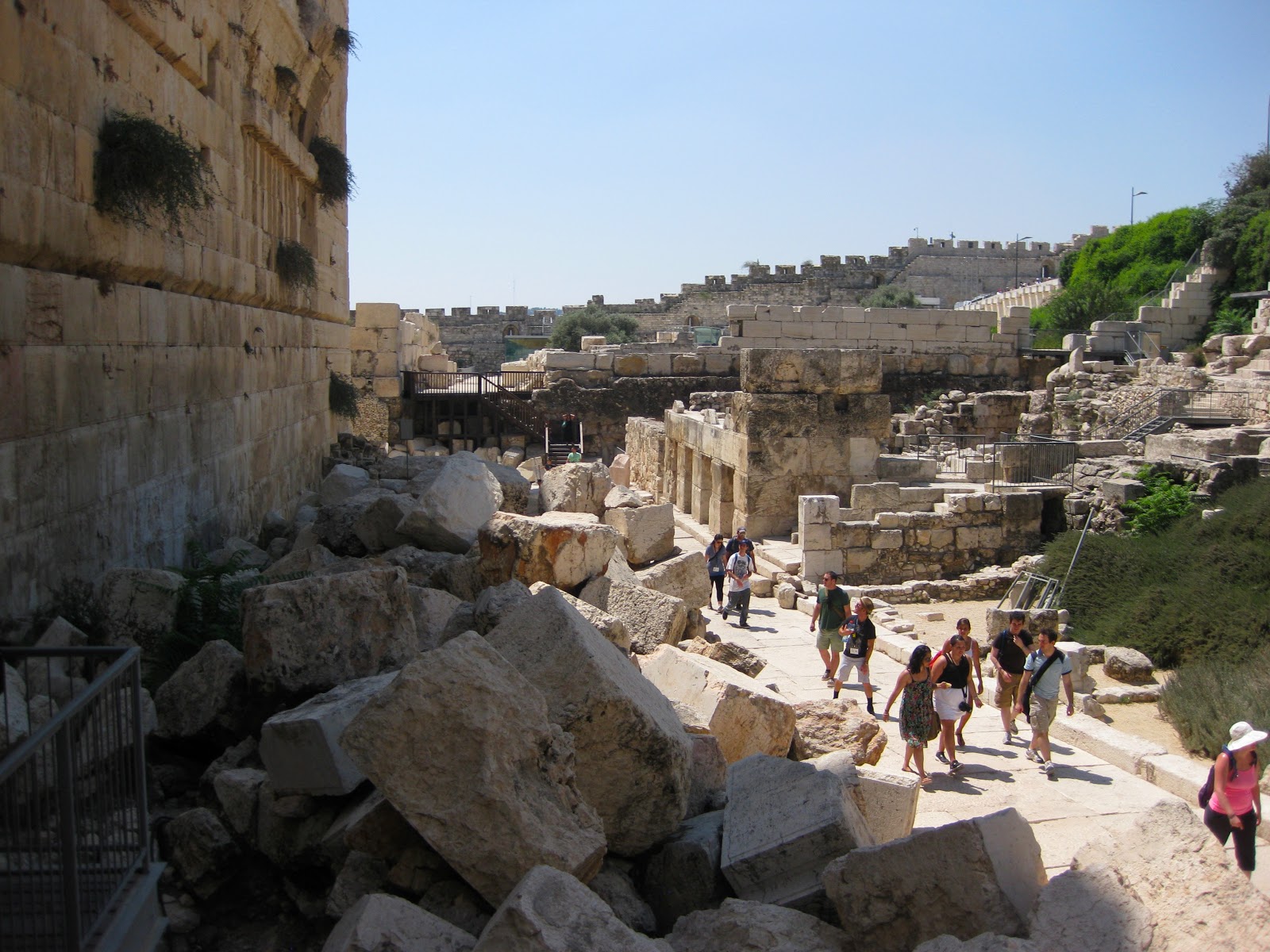
Intermingled ruins of 2000 years.
Team Shlomo relaxes beneath an olive tree in the old city. [taken by Benny Berezin]
Walking by more ruins along the western side of the Temple Mount.
Approaching noon, we headed deeper into the center of the city to pay our respects at the Western Wall. I had been struggling to come up with something I wanted to write as a message to stick in the wall right up until the time we got there. Einat said something which really spoke to me before we went in, which got my mind going, discussing what it meant to be Jewish. I had my mind pretty made up that she was devout from the moment we met her, but in walking around the ruins on the skirt of the city, she mentioned that she was not very religious, and yet Judaism connects all of us in the group, bringing us here to Israel and experiencing these religious sites together. That admission combined with my feelings of being in the country the past two to three days inspired me to jot down some thoughts on what my pilgrimage meant to me, which I wanted to part with at the wall.
Upon entering the men's section for prayer (roughly four times as big as the women's section, including indoor portions) I took a yamilka, and I was immediately after approached by elder Hasidic Jews, who wanted to know whether I was myself visiting the wall as a Jew. When I replied "yes," they immediately pulled me—almost physically—over to a little station where I was wrapped with tiffillin and tallit, while being led through a prayer. When asked what my name was, I instinctually replied Adrian, but much like when I would say my name in Italy, the Israeli man did not understand, so I repeated: Aaron. Our conversation with the artist in Tzfat about the Kabbalah and the importance of names—he gave up his English name Robert when he moved to Israel to take on his Jewish persona of Avraham—inspired me to share my Hebrew name. I have never up to this point had a reason to use it, but it felt right at that moment, assuming a Jewish identity in context just as I became Adriano Ponti in Italia. The man immediately understood, and gave me one more prayer to read at the wall, which I did, following the English translation.
I think I can safely say that this experience of attending the Western Wall didn't mean nearly as much to me as to nearly everyone else there, but I am still happy that I had the chance to make that trip not only as a tourist and observer, but as a Jew.
The Wailing Wall: women to the right, men to the left.
Me, wrapped in tiffillin and tallit at the wall. The man who took my picture asked me to hold out my left arm, with the tiffillin, to show I was a "strong Jewish man." I half-heartedly obliged.
We were given the next hour or so to get lunch and hang out in the Jewish Quarter. A little tired of falafel and shwarma, I went to an "Italian" place, ordering a dish of penne in a mushroom cream sauce. I was at first a little apprehensive about getting cream on such a hot day, but it turned out that just meant there was shredded cheese over top, which gave necessary flavor to the otherwise bland but well-cooked pasta.
The next few hours were reserved for free time at the hotel, where we got to use the pool, although during the week it was split between mens' and womens' times. I was fortunate that most of the time while we were around happened to be mens hour, but many of the women felt there might be some sexism involved, especially after seeing how uneven the split of the Western Wall was. We played volleyball in the pool with some Hasids, who brought the ball, until someone hit it over the wall of the eighth floor rooftop pool. Someone eventually recovered it, but at that point nobody was interested in playing. I was able to get a few laps in though during the intervening time with the pool more clear.
A family walks through the Jewish Quarter.
A group of my peers do some improv comedy outside the Hurva synagogue.
Catching some music at the Jaffa Gate.
Outside the old city.
At 5:15 we met for Shabbat in the lobby with everyone dressed up, a little like prom for birthright. We bussed into the old city and had our own memorable service in an empty courtyard overlooking the Western Wall some 500 feet away. We had some poetry and prose readings about the meaning of Shabbat, the day of rest, the lighting of the candles, and also had an open discussion of what Shabbat meant to us. We ended with some Hebrew songs/prayers, which led to a bit of dancing, and then we were given another half-hour to see the wall up close.
Having been earlier in the day, we were not wrapped in tiffillin or tallit, but it was even more special to be there around so many other people coming to pray at the end of the week. I particularly enjoyed something Einat said right before we went to the wall: all the Jews around the world are looking at us right now, on this night. It is something I hadn't really considered prior but made me feel my trip was that much more special.
We left the wall just before sunset as the area swelled with people coming to pray. This second time in the city the streets were much quieter, as everyone prepared for and celebrated Shabbat. We passed through blocks seeing only a handful of people and those we encountered were on their way to mark their own day of rest. On our walk back to the hotel—our bus driver Schlomo was with his own family celebrating Shabbat—we did not see a single moving vehicle. It is something I get a taste of at home in Bala Cynwyd where all the Hasidic Jews are out walking on Friday night and Saturday, but not entirely absent. It was fascinating, seeing the open streets not by government intervention but through personal choice.
We arrived at the hotel for a rather late dinner. Everyone was pretty starving, but we first commemorated our Shabbat meal with kiddush and motzi. Even after a long day, most everybody was around to hang out deep into the night knowing that we had a late start and smaller program for Shabbat the following day, and we conversed both with each other and with other birthright groups from America and Russia into the wee hours of the morning.
Returning to the old city for Shabbat.
Interesting light fixtures by the Jaffa gate that I at first thought had some memorial significance—doesn't everything here?
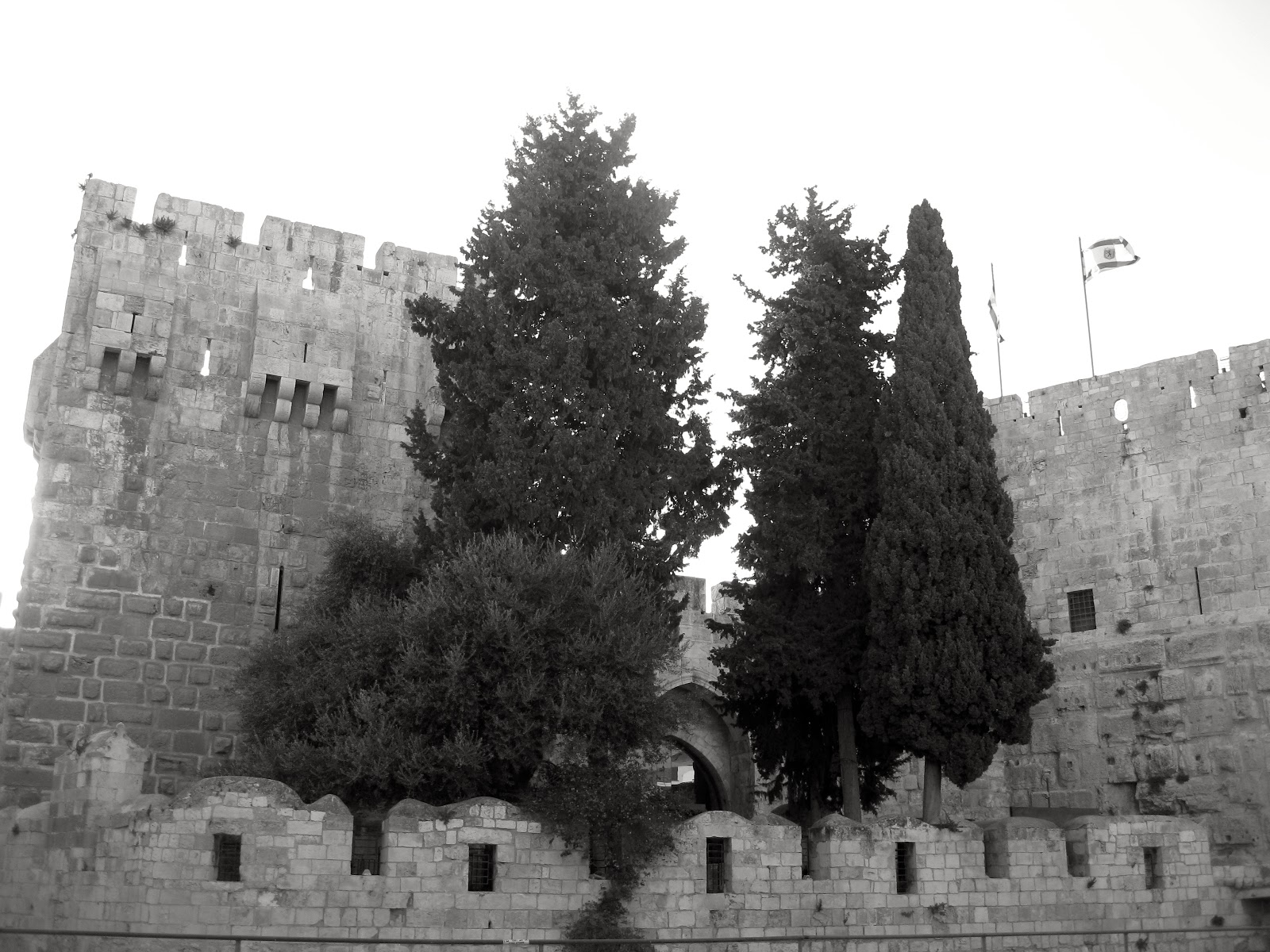
The Tower of David
On the edge of the Armenian Quarter.
Einat and Rebecca Dirks lead the way into the Jewish Quarter.
Our view of the Wailing Wall from the courtyard where we celebrated Shabbat.
Sunset in Jerusalem, facing east.
Nighttime at the wall
Hurva Synagogue, at the center of the Jewish Quarter.
The old citadel, in the Armenian Quarter.
The Tower of David by night
Team Shlomo interrupts the otherwise quiet and empty streets of Jerusalem.
Our first activity for the day again began at 8:00 as we headed off to Mount Scopus overlooking the old city of Jerusalem (above). Our guide, Einat, pointed out several destinations within the old city, laying out the general geography for us along with some of the historical context for the city and its passage through the hands of many rulers through the past several thousand years.
Einat asked for volunteers to pour kiddush wine at the top of the mount, at which point I was nominated by a chorus of my peers, who at this point well knew my experience with wine. I impressed myself as well as some of my peers when I was able to pour 45 nearly even cups of wine from a single bottle, leaving only two servings to spare. At this point, I've become the "wine guy" in the group, with my peers every so often asking me about certain wine-drinking norms both during the day and after hours at the hotel bar.
We next headed into the old city, marked by the Ottoman-built wall during their time as rulers of the city. We walked along the southern perimeter from the Zion gate to the south end of the Temple Mount, which used to include several entrances to the top of the mount, which are now blocked with stone. Along the way we saw remnants of each of the former ruling groups, as vestiges of Ancient Israelite, Byzantine, Umayyad, Ottoman, and British civilizations sat alongside accommodations by the modern Israeli state.
Mishkenot Sha’ananim, the first Jewish neighborhood built outside the Old City, including the Montefiore Windmill.
The Dome Of The Rock, seen from the south end of the Jewish Quarter.
The southwest corner of the Temple Mount.
Einat, alone at stairs leading up to the south end of the Temple Mount (outside the Ottoman wall), where the former entrances are now blocked.
Intermingled ruins of 2000 years.
Team Shlomo relaxes beneath an olive tree in the old city. [taken by Benny Berezin]
Walking by more ruins along the western side of the Temple Mount.
Approaching noon, we headed deeper into the center of the city to pay our respects at the Western Wall. I had been struggling to come up with something I wanted to write as a message to stick in the wall right up until the time we got there. Einat said something which really spoke to me before we went in, which got my mind going, discussing what it meant to be Jewish. I had my mind pretty made up that she was devout from the moment we met her, but in walking around the ruins on the skirt of the city, she mentioned that she was not very religious, and yet Judaism connects all of us in the group, bringing us here to Israel and experiencing these religious sites together. That admission combined with my feelings of being in the country the past two to three days inspired me to jot down some thoughts on what my pilgrimage meant to me, which I wanted to part with at the wall.
Upon entering the men's section for prayer (roughly four times as big as the women's section, including indoor portions) I took a yamilka, and I was immediately after approached by elder Hasidic Jews, who wanted to know whether I was myself visiting the wall as a Jew. When I replied "yes," they immediately pulled me—almost physically—over to a little station where I was wrapped with tiffillin and tallit, while being led through a prayer. When asked what my name was, I instinctually replied Adrian, but much like when I would say my name in Italy, the Israeli man did not understand, so I repeated: Aaron. Our conversation with the artist in Tzfat about the Kabbalah and the importance of names—he gave up his English name Robert when he moved to Israel to take on his Jewish persona of Avraham—inspired me to share my Hebrew name. I have never up to this point had a reason to use it, but it felt right at that moment, assuming a Jewish identity in context just as I became Adriano Ponti in Italia. The man immediately understood, and gave me one more prayer to read at the wall, which I did, following the English translation.
I think I can safely say that this experience of attending the Western Wall didn't mean nearly as much to me as to nearly everyone else there, but I am still happy that I had the chance to make that trip not only as a tourist and observer, but as a Jew.
The Wailing Wall: women to the right, men to the left.
Me, wrapped in tiffillin and tallit at the wall. The man who took my picture asked me to hold out my left arm, with the tiffillin, to show I was a "strong Jewish man." I half-heartedly obliged.
We were given the next hour or so to get lunch and hang out in the Jewish Quarter. A little tired of falafel and shwarma, I went to an "Italian" place, ordering a dish of penne in a mushroom cream sauce. I was at first a little apprehensive about getting cream on such a hot day, but it turned out that just meant there was shredded cheese over top, which gave necessary flavor to the otherwise bland but well-cooked pasta.
The next few hours were reserved for free time at the hotel, where we got to use the pool, although during the week it was split between mens' and womens' times. I was fortunate that most of the time while we were around happened to be mens hour, but many of the women felt there might be some sexism involved, especially after seeing how uneven the split of the Western Wall was. We played volleyball in the pool with some Hasids, who brought the ball, until someone hit it over the wall of the eighth floor rooftop pool. Someone eventually recovered it, but at that point nobody was interested in playing. I was able to get a few laps in though during the intervening time with the pool more clear.
A family walks through the Jewish Quarter.
A group of my peers do some improv comedy outside the Hurva synagogue.
Catching some music at the Jaffa Gate.
Outside the old city.
At 5:15 we met for Shabbat in the lobby with everyone dressed up, a little like prom for birthright. We bussed into the old city and had our own memorable service in an empty courtyard overlooking the Western Wall some 500 feet away. We had some poetry and prose readings about the meaning of Shabbat, the day of rest, the lighting of the candles, and also had an open discussion of what Shabbat meant to us. We ended with some Hebrew songs/prayers, which led to a bit of dancing, and then we were given another half-hour to see the wall up close.
Having been earlier in the day, we were not wrapped in tiffillin or tallit, but it was even more special to be there around so many other people coming to pray at the end of the week. I particularly enjoyed something Einat said right before we went to the wall: all the Jews around the world are looking at us right now, on this night. It is something I hadn't really considered prior but made me feel my trip was that much more special.
We left the wall just before sunset as the area swelled with people coming to pray. This second time in the city the streets were much quieter, as everyone prepared for and celebrated Shabbat. We passed through blocks seeing only a handful of people and those we encountered were on their way to mark their own day of rest. On our walk back to the hotel—our bus driver Schlomo was with his own family celebrating Shabbat—we did not see a single moving vehicle. It is something I get a taste of at home in Bala Cynwyd where all the Hasidic Jews are out walking on Friday night and Saturday, but not entirely absent. It was fascinating, seeing the open streets not by government intervention but through personal choice.
We arrived at the hotel for a rather late dinner. Everyone was pretty starving, but we first commemorated our Shabbat meal with kiddush and motzi. Even after a long day, most everybody was around to hang out deep into the night knowing that we had a late start and smaller program for Shabbat the following day, and we conversed both with each other and with other birthright groups from America and Russia into the wee hours of the morning.
Returning to the old city for Shabbat.
Interesting light fixtures by the Jaffa gate that I at first thought had some memorial significance—doesn't everything here?
The Tower of David
On the edge of the Armenian Quarter.
Einat and Rebecca Dirks lead the way into the Jewish Quarter.
Our view of the Wailing Wall from the courtyard where we celebrated Shabbat.
Sunset in Jerusalem, facing east.
Nighttime at the wall
Hurva Synagogue, at the center of the Jewish Quarter.
The old citadel, in the Armenian Quarter.
The Tower of David by night
Team Shlomo interrupts the otherwise quiet and empty streets of Jerusalem.
Subscribe to:
Posts (Atom)


.jpg)